
Washington’s public forests belong to all of us. Yet major policy changes could open millions of acres to increased logging while limiting public oversight. Understanding how federal forests are managed—and how the public can influence those decisions—has never been more important.
Forest Are Worth More Standing!
Washington is one of the most forested states in the country. Roughly 22.5 million acres—about half the state’s land area—are forestland, containing an estimated 9.4 billion living trees.
A large portion of these forests are publicly owned. The United States Forest Service manages about 12.7 million acres, making it the largest forest manager in Washington State.
These forests are part of a regional system managed by the Forest Service. Washington and Oregon fall within Region 6, the Pacific Northwest Region. Within this structure, Region 6 includes 16 National Forests, six of which are primarily located in Washington. Each forest is further divided into Ranger Districts, where many on-the-ground management decisions are made.
Because these lands belong to the public, their future depends heavily on public participation and oversight.
Why These Forests Matter
The forests of the Pacific Northwest are globally significant ecosystems. They provide:
-
Critical habitat for wildlife and biodiversity
-
Massive carbon storage that helps stabilize climate
-
Clean water systems for downstream communities
-
Recreation and cultural value
The region also connects to larger forest ecosystems across the West, including places like the Tongass National Forest in Alaska, the world’s largest intact temperate rainforest. These landscapes demonstrate the ecological importance of protecting mature and old-growth forests across federal lands.
Emerging Threats to Federal Forest Protections
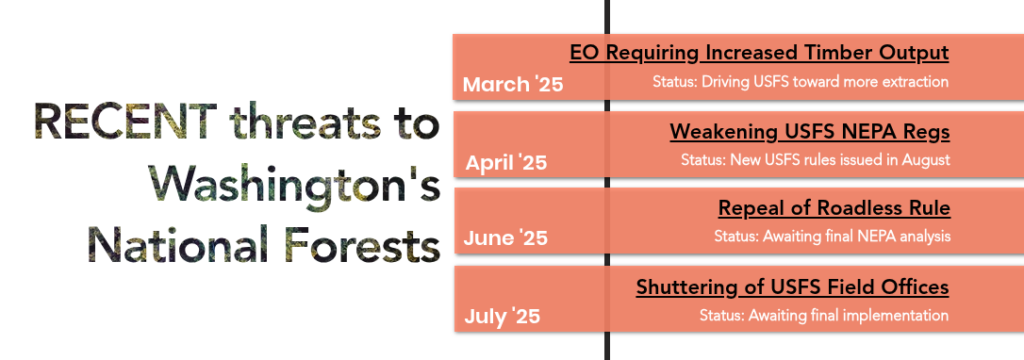
Several recent policy changes and proposals could significantly increase logging and reduce public oversight of national forests.
These include:
-
Executive actions pushing the Forest Service to increase timber production
-
Changes to environmental review rules that weaken the National Environmental Policy Act process
-
Proposed repeal of the Roadless Rule, which protects undeveloped backcountry areas
-
Closure of local Forest Service offices that support community engagement
Together, these changes could accelerate extraction while limiting the public’s ability to influence decisions affecting millions of acres of forest.
A Key Tool: The NEPA Process
The National Environmental Policy Act (NEPA) provides one of the most important ways the public can participate in federal land management.
Before approving major actions that significantly affect the environment, federal agencies must:
-
Study environmental impacts
-
Consider alternatives
-
Publish documentation
-
Allow time for public comment
Well-informed public comments submitted through NEPA often influence project outcomes and improve environmental protections.
Current Campaign: The Fix Our Forests Act
One major federal proposal currently under debate is the Fix Our Forests Act.
The bill is promoted as a wildfire prevention strategy, but critics warn it could dramatically weaken oversight of federal forest management. Among other changes, it would create large “Fireshed Management Areas” where logging projects of up to 10,000 acres could occur with reduced environmental review and limited public input.
Supporters argue the bill would help address wildfire risk. Opponents say it prioritizes industrial logging while failing to fund proven wildfire solutions such as home hardening, defensible space programs, and prescribed fire.
The bill passed the U.S. House in 2025 and could receive a full Senate vote in 2026.
What You Can Do
Public forests depend on public engagement. A few ways to make a difference include:
-
Calling or emailing your members of Congress
-
Attending town halls and public meetings
-
Submitting comments on federal forest projects
-
Staying informed about legislation affecting public lands
Advocates often say the most powerful message to legislators is simple: our forests are worth more standing than cut down.
America’s national forests are a shared inheritance. Protecting them requires informed citizens willing to participate in the decisions that shape their future. Please read more about Priority 1 and Priority 2 at Legacy Forest Defense Coalition.